


And once you understand what it means, you will never think about your career, your talent, or your own potential in quite the same way again.
It does not have a direct English translation. That is actually the point.
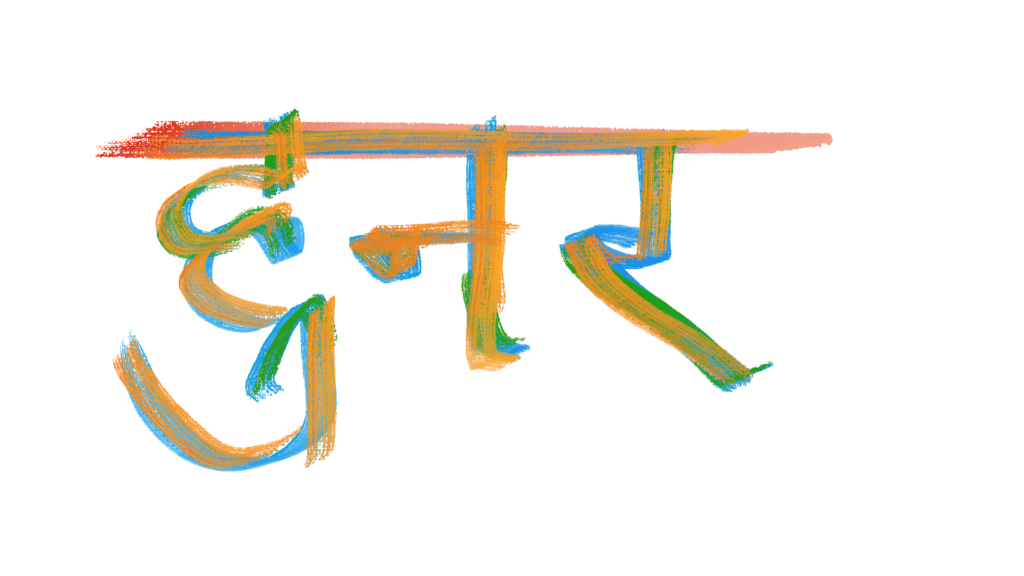
Hunar refers to something between mastery and artistry, a quality of ability that goes so deep it becomes inseparable from who you are. Not what you do, but how you exist while you do it. The closest English phrases like “gift,” “genius,” “calling” etc all land somewhere near it but none of them land on it exactly.
Skill, Talent or Hunar?
Lets simplify these terms even though we are tempted to use them interchangeably
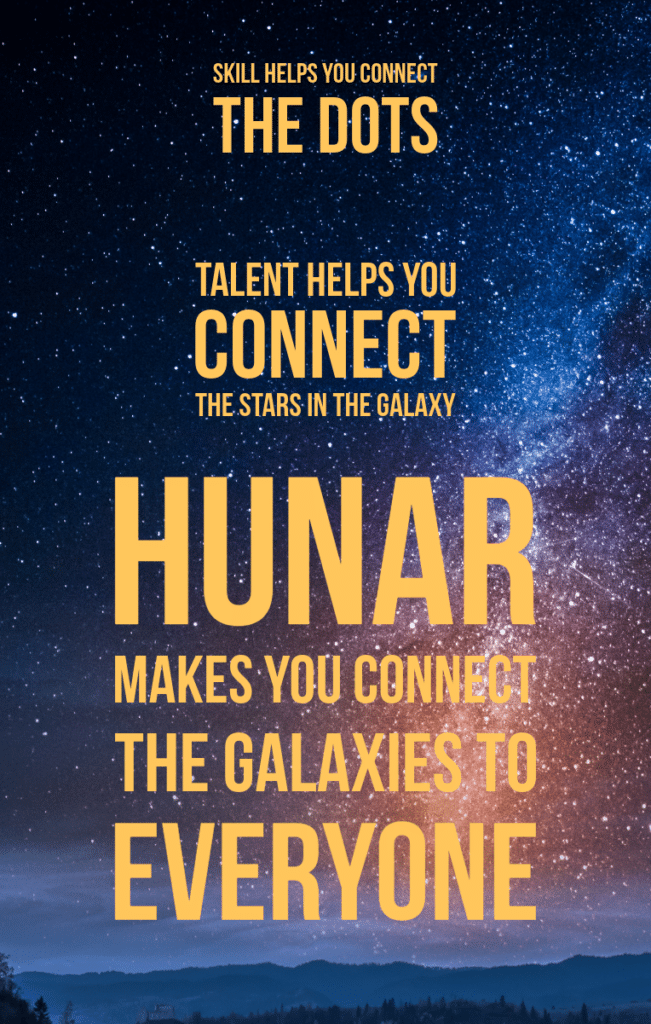
Skill is something you learn.
Imagine you want to ride a bike. The first time, you fall. You try again. You fall again. But slowly, day by day, you get better. After a few weeks, you can ride without thinking about it. That is a skill. You were not born knowing how to ride a bike. You learned it. Anyone can learn it if they practice enough.Skills are everywhere. Reading. Typing. Cooking an egg. Playing a chord on a guitar. Kicking a penalty. All of these are things a person can learn if they put in the time.
The important thing about skills is this: if you can learn it, someone (esp AI) can learn it.
Talent opens a door. It does not walk you through it
Some kids pick up a basketball for the first time and it just feels right in their hands. Some kids hear a song once and can hum it back perfectly. Some kids look at a math problem and see the answer before they have even picked up a pencil. That is talent. It is a head start. It is something in your wiring that makes certain things come more easily to you than they do to most people.
Plenty of people with no obvious talent work so hard, for so long, that they end up doing extraordinary things.
Hunar is more than skill and more than talent put together
I asked a very well known musician, “What does a maestro do that a highly skilled practitioner cannot?” She reflected for a few minutes and said, “The maestro is one with the music, the instrument, the atmosphere and mood in the auditorium and get everyone to feel the same emotion.”
Skills Have a Short Shelf Life. Hunar Does Not.
A skill is learnable. It can be taught in a course, tested in a certification, listed on a resume. A skilled professional follows the playbook. They do the job well. They know the steps.
And right now, AI can do the steps.
That is not an exaggeration or a scare tactic. It is what is already happening across professions like law, medicine, design, finance, writing, and certainly ... code. AI is fast, accurate, tireless, and getting better at the technical parts of almost every job that exists.
Which raises the question: what exactly cannot be replaced?
The answer is Hunar.

Skills Have a Short Shelf Life. Hunar Does Not.
A skill is learnable. It can be taught in a course, tested in a certification, listed on a resume. A skilled professional follows the playbook. They do the job well. They know the steps.
And right now, AI can do the steps.
That is not an exaggeration or a scare tactic. It is what is already happening across professions like law, medicine, design, finance, writing, and certainly ... code. AI is fast, accurate, tireless, and getting better at the technical parts of almost every job that exists.
Which raises the question: what exactly cannot be replaced?
The answer is Hunar.

Consider Zaha Hadid. Trained in London, born in Baghdad, she knew everything a world-class architect is supposed to know. Structural calculation, spatial planning, technical draftsmanship -- she had all of it. So did thousands of other architects.
But for fifteen years, nothing she designed got built. Critics called her “the paper architect.” Her proposals won competitions and sat in drawers.
Her work was not within the accepted box -- she said so herself. But the box did not change her. She kept designing.
Her Hunar was the way she felt space differently from everyone around her. Where other architects drew walls, she saw movement frozen in time. Where others saw a corner, she saw a curve that had not been released yet. She described architecture as being about well-being and pleasure, not just shelter -- and she designed every building as if the person moving through it was the only thing that mattered. She did not design structures. She designed experiences that had not yet been built.
When her buildings finally started rising -- the MAXXI Museum in Rome, the Heydar Aliyev Center in Baku, the London Aquatics Centre -- the architectural world ran out of language to describe them.
That is what Hunar looks like from the outside. Fifteen years of silence followed by work that nobody else could have made.
What Makes Hunar Different from Talent
Talent is something you are born with. Skill is something you practice. Hunar is something that emerges when talent meets years of disciplined devotion and becomes fused with your identity.
It is the extra layer of attention a great doctor brings when the chart says one thing and something else feels wrong. It is the way a great teacher can sense when a child has stopped listening not because of anything visible, but because of something in the room. It is the quality a great leader carries that makes the people around them raise their game without being asked.
None of those things can be automated. Not because the technology is not there yet. Because they are not, at their core, information-processing tasks. They are expressions of a whole human being, shaped by a particular life, operating at a level of integration that no system can replicate.
Hunar Is What Makes You Irreplaceable
Here is what the age of AI is actually asking us to do: stop competing on skill and start discovering your own Hunar.
Skills get you hired. They open the door. But in a world where AI can match or exceed most technical skills at a fraction of the cost, skills alone are no longer enough to make you indispensable.
Hunar is what keeps you in the room and in the hearts.
How to Recognize Your Own Hunar
It is probably not where you expect to find it.
Hunar shows up in the work you would do even if no one paid you. In the problem you notice that no one else seems to see. In the moment when everyone else is following the playbook and something in you says -- quietly, without drama -- that there is a better way.
It lives in the place where your natural wiring, your years of practice, and your particular way of caring about the world all converge. Some people find it early. Most people find it by accident, midway through a career, when they realize that the thing they thought was just how they worked is actually what makes them different from everyone else who does what they do.
Zaha Hadid spent fifteen years being told her Hunar had no place in the world.
She kept going anyway until she passed away on March 31-2016
The buildings are still standing. Hunar is what makes you irreplaceable.


